Search This Blog

Loading...

Tuesday, March 12, 2013

Next Meeting Thursday 3/14 Raw Or/e

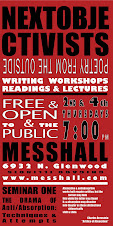
The Next meeting of the Next Objectivists is Thursday 3/14 at the Mess Hall in Rogers Park.We hope old and new members will join us for our penultimate meeting in the space where the Next Objectivists conceived themselves more than five (5) years ago. 

At our last meeting, on February 28, we began to compose a new chapbook. Periodically, the workshop produces collections of poetry based on source texts and authored - or better, transcribed and edited - by the group. Our goal is to carry the Objectivist poetic practices of the 1930s-60s into the future by generating truly multi-authored and anonymous texts: ones which can be ascribed only to a collective entity.

Following is a brief description of the procedures we followed to create the "Raw Or/e" as we call it--the material the comprises the first draft of some future collection. The Or/e is also below. 

Notes from meeting of 28 February 2013.

After reading aloud & discussing The Hardy Boys Poems by Eric Wayne Dickey, recently published by BeardofBees press, each of us took up a book from the pile of Nancy Drew and Hardy Boys mysteries on the table. Thinking about the Freudian notion of desire which Dickey employs to TWIST the poems away from normativity by adding a libidinal supplement of his own (sometimes 'straying' so far from the source text as to produce Hardy Boys erotica), we determined that an objectivist method would require that we did not, at least initially, rewrite or supplement the source texts. We would preserve the sentences of the source texts and not add ones of our own, but only juxtapose what was already given. Noting how Dickey's book maintains a kind of perverted satire of 1950s-era American values, we wondered if we might generate similarly satirical effects through juxtaposition. As an initial gesture toward a collaborative writing project, we decided to begin by choosing passages from the source texts that emphasized the bizarre nature of the “mystery” plots; the initial idea was to generate a sense of “information overload.” Whereas Dickey focusing on character and personality—adding a libido missing from the stories—we would focus on plot. We would pay particular attention to passages that expressed huge realizations—what in Aristotelian terms we might think of as “recognitions” and “reversals.” We developed these basic rules:
  1. We would try to choose passages of revelatory moments.
  2. We would also choose plot elements related to these moments: scenes of discovery.
  3. We would focus upon empty revelations, and perhaps empty out revelation.

Our procedure involved group improvisation and transcription.

Sitting around the table, each person would read aloud one or several sentences. These would be typed onto a tabloid sized sheet, generating the raw or/e. But more importantly, everyone else in the group (there were 12 of us around the table, although as always the group's size fluctuated as people came and went) listened to the passage. Someone then 'responded' by reading aloud a passage that met the basic requirements of the game and also elaborated upon, extended, or juxtaposed its signification with that of the previous passage. As we continued this practice, we began to develop a tempo and slowly our thoughts began to harmonize. We found the game enjoyable and attempted several more rounds, each time discussing and slightly refining our basic practice, without significantly altering the rules (long since abandoned to the pleasures of improvisation).

Following are the results of this exercise: three “rounds” of improvised group juxtaposition of sentences from the source texts. The transcription, made by electric typewriter, was in prose. During the second round, we also inserted the rule that anyone could at any time signal a “paragraph break,” in order to divide the source text into smaller units. These breaks emerged spontaneously.

As an extension of the experiment, I broke the result of round one into basic poetic units when transcribing them: rough tetrameters, couplets and triplets.

Raw Or/e 2.28.13

Drawn from a variety of Nancy Drew and Hardy Boys mysteries, through an improvisatory method.


Round One

A single wrong twist of the wheel
could mean a fatal plunge
into the valley below. Frank drove
swiftly, but with a firm hand.

“All I ever got out of your cases
is bruises.” “You snooping busy-bodies!”
Raskin's voice snarled in Nancy's ear.
“This is the last time you're going

to get in our way.” “Young lady,
you've broken the law. You're in trouble
with the authorities!” “By the way,”
Frank went on, “where do you buy

your sapphires?” Now it is all
factory-made suits. There is no real work
for a tailor anymore. Only patching holes,
altering. The smell of new cloth

and leather goods pervaded
the huge store. Crowds moved about,
inspecting hundreds of items,
from camping gear to sports clothes.

We put them in a trashcan. Good place
for them. Just then, Frank heard
the sound of a car starting up
in the distance. “There they go!”

Apparently they thought George was a man
and they wanted no part of a judo encounter.

You mean there's something the matter with the man
she's going to marry? With a blast of exhaust,

they took off after the fleeing car. You saw giants
on the desert, giants better than a hundred feet tall.

“We'll tie 'em good this time so they'll stay put.”
Pick replied coldly, “that would be you're death warrant.

Now scram out of this territory.” “Should we tie up
and look around?” Chet asked. The Indians couldn't

see them, but we can! Crimes big or little are so
useless. What ever profits they may bring are always

temporary. Or Edgar could be using aliases.
The pilot grinned, “any time fellows.” “Who are you?

What's your name?” Frank asked. “Wait . . . not . . . now . . .
later.” Bubbles appeared in the beaker and the lime-water

turned cloudy, then clear again. “Limestone it is!”
Joe exclaimed. “I knew it! This is what comes of meddling

with mysteries!” “You see, where I was brought up
us sailors meant washing dishes when we said pearl diving.”

“Suppose you look
in the kitchen, just
in case,” Frank suggested.

Bliff shrugged.
“Who knows?
Maybe they thought

his jewels were real!”
Chet felt the cool grass
come up and hit

his face. “Everybody
is so kind to me except—
except my mother.”

He had a limp until
he was cornered and then
he could run like a deer.


Round Two

“No. But I just have a strong hunch that there might be a fake Nancy Smith Drew posing as the real one.” The stout boy beamed with pride, “that shot-putting stuff came in handy, eh?” They ascended the stairs to the rear entrance and knocked. A thin old man opened the door. Nancy tooted again. “By the way,” Sam asked as they pulled into the driveway, “have you heard from my wife?” “Don't ask me who did it. There I was rushing to find you two when Biff! I saw stars. Frank wondered if the pilot could mean component parts for atomic weapons. “Now who'd do a thing like that?” Joe asked.

“Whoever stole it,” Frank commented, “must have. realized he couldn't get very far with it.” “There's no question but that this is pirated from ours! Now we have something concrete. We'll go after these thieves!” “Our phone bill will be tremendous.” Frank gave a gasp. “You hit the nail on the head!”

“Hey fellows,” Chet said, “I hate to spoil a good ice-cream bar, but those not too friendly friends of ours are over there.” “They're my babies. You can't take them away!” After all, this is a public park, and people come and go. Well, I'll be a cross-eyed monkey. You certainly had us fooled. Jack turned around. “Hey did you say three for me? I only brought two.” “But Eddy at the soda shop says you ordered a record,” Nancy said. “When and why did you do that?” Then she began to quote from Shakespeare,
But love is blind, and lovers
Can not see
The pretty follies that themselves
Commit.

“Remind me to have his adenoids removed,” Biff said with a chuckle. “I know how quiet it will be,” snapped their aunt. “Just one danger after another.” Frank strained his ears, wondering if he was mistaken. Then he heard it again. A faint scratching noise which he could not identify. “You all right?” Joe asked. “Yes, but my head feels like a balloon.” “I know what you mean.” Things aren't any easier, even though I have a job. I can't blame them for being curious,” Jack said. “I'll bet its not very often that he sees a helicopter hanging over the lake, then dredge up a whale and tow it to shore.” “You can't do this to us. It's illegal!” It was Mungo speaking. “Look whose talking about legality,” someone said with a laugh. While Frank distracted the detectives' attention, Joe gave the zipper a quick jerk. “The monkey man!” Frank exclaimed. “Joe, he's the man in the yellow coat!” Joe pulled the zipper shut before Stanley noticed anything. The young detective's mind was racing.

“Yup, the woods is no place for kid stuff. You've got to be on the lookout.” “Half the city of London!” “Too bad,” said Nancy. “Ah, Bueno!” “Let's see, what shall we get, coon hound? No. Too big. Blood hound? Too gloomy. Basset? Too fat and its legs are too short.” “I can't wait to get out west and try some of that Mexican food.

“You're in the money,” Joe quipped. “What are you going to do with half of London?” “We'll tune her up and she'll be ready to go.” Ned spoke up, “If Edgar Nixon is as slick as you think, Nancy, I bet I know what his next move was.” “Why you're a young lady now,” she laughed. “Say, take the light out of a fellow's face,” he protested feebly. “And what have you two done with my clothes?” “I'm glad I caught you boys. I've been on the road since dawn, and uncovered one of the neatest ways of defrauding the government I've ever run into. “Now see here, young lady. You're not going to get rid of me that fast. Give me ten dollars and I'll go.” “I guess you won't need it,” Hamilton replied with a cheery grin.


Round Three

“All these chambers and passages were hewn out of natural caverns by the abolitionists when they built the cabin against the front of the rock wall.” Ira took a slip of paper from the pocket of his bathrobe. “I've never believed in ghosts, but now I'm afraid I do!” Meanwhile, Chet stowed the baggage in the fuselage, finding a special place for his infrared camera. “This mystery is turning out in reverse!” said Joe. The manager put through a call and carried on a rapid, pleasant conversation in Spanish. When he hung up he turned to the boys with a smile. “I wouldn't want to start anything for the world.”

Up in the control tower the operator barked the orders into his mic. “That calls for extra big helpings of strawberry shortcake!” Thurston glared balefully at the Hardys but said nothing. “I don't approve of young girls having cars.” There was no one in sight and finally she stood up and waded ashore. A chill breeze struck her and she began to shiver. The young Hardy pilot, the one they're after for causing the near-crash near Chicago. The girls returned to the car. In vain they searched through the throngs of people watching the parade.

“I'll get you for this,” he threatened. “That Edgar Dixon is a biagmist – or even a trigamist?” “I hope it's not one of those self-locking doors.” “What say we have lunch before we start?” “Oh, Nancy, you're a genius!” “Are you sure?” “It's like a beautiful dream!” “Were you friends with the deceased?” Ira Nixon slumped forward in a faint! “Only six weeks more until my retirement and now this disgrace!” “Maybe we can nail the men when they come out the other end of the tunnel!” “Oh, who would want to do such a thing?” “It's your turn, Chet! Get a soft spot ready on your shoulder!” “It's my turn now.” “Do you suppose they'd be offended if I left five dollars?” “Si, si! But be careful – por favor! Nancy was happy over this and hoped the good relationship would last!

Saturday, January 26, 2013

Next Objectivists Meeting Notes 17 January 2013

The Next Objectivists, founded in January 2008, begin our SIXTH year as the world only 100% autonomous Poetry & Poetics Workshop dedicated to the study & reproduction of writing in the objectivist tradition—writing alive to what we call the OUTSIDEREAL—with a six-session seminar devoted to the production of a new piece of collectively produced objectivist poetry.

During the first three sessions, we read pairs of texts that adhere to a narrow set of “objectivist” principles. All the texts are based on prior texts, which are “edited” and juxtaposed in order to employ aesthetics in the production of truths that emerge from and exceed the subjective experience normally accorded to lyric writing.

During the first session of this seminar, held on January 17, 2013, we read excerpts from Charles Reznikoff's Holocaust & Eliot Weinberger's What I Heard about Iraq in 2005. Both texts use objectivist poetic techniques to investigate and intervene in knowledge making around horrific historical events. In the first case, Reznikoff draws on Nuremberg trial testimony to memorialize the holocaust, revealing the textures of industrialized genocide. In the second case, Weinberger, one of the few contemporary writers to cite Reznikoff as a mentor, draws on newspapers and blog posts to intervene in the management of public sentiment during the invasion and occupation of Iraq.

Here are some scattered notes from our conversation:

The importance of truth, compared to facts. The “truth” of an event as a moral impulse that organizes from among the collection of facts made available a principle of orientation. In this sense, we are exploring the 'subjective' aspects of objectivist poetics. We are worried abou the presumption of universal truth and its relation to facts. What stance shall we take to the production of “social realities” and their seemingly inevitable failures? Immediately we notice how Reznikoff's writing problematizes the truth – convincing yet leaving one asking questions about the collective work of authorship that brings this reality into the imagination.

Consider as an alternative approach the stories of survivors articulated by Elie Wiesel. Perhaps upon reading Twilight you thought the survivor would embrace life, but in the end he decides to live with the lie. He lies precisely because he doesn't want to live anymore. Were he to overcome the tragedy, this would make you or me feel better. Regarding the subjectivity of the reader of this fiction: you want the hope. You want closure, but not the wrong kind.

Optimistic objectivity leaves open the gateway to the truth.Pessimistic objectivity cancels the truth of the event by launching the critique of universal slipperiness. It's claim is always that there is no objective truth—ultimately a question about whether or not a workshop based on objectivist poetics is deconstructive or constructive—do we, in our desire for objectivity, reveal its impossibility? Or create a collective objectivity? Are you after mob action & genocide or are you after the truth?

In Wiesel story: the question of whether or not there's a point of living after the holocaust. The anecdote of the survivor. The trouble with children. Killing the child to save the family. Suffocating the wailing baby. The turning of people into objects. “Realness,” in Reznikoff's poetry, is depersonalized. The anti-septic nature of Reznikoff's testimony. The oppressed in Reznikoff seems incapable of these things. They are victims, caught in an absolute violence. Two forms of utilitarianism. The blankness of the system of industrial warfare vs the blankness of the moral parable, as in Wiesel.

Or consider J. S. Prynne's point: The question is always, what truth are we looking for? Truth has to be confined. This is the kind of knowledge we want; people think of truth as non-contingent. What qualifies as proof? In a post-structuralist world, all we have is texts, constructed realities. We can see the realities that are constructed toward us. That face us; that we are made to face. Objectivity as a fantasy; its actually intersubjectivity. THE IMAGINATION IS OBJECTIVE. (It grasps the object in the language of the other.)

We consider the the aesthetic rules, the techniques or mechanisms employed in Reznikoff's poem:
  1. Being mundane; stripping away the emotions. When putting it into writing, you strip away the emotion. Or is it stripping away emotion? You come to your own conclusion. No interpretation for the reader. The images, scenes, scenarios determine the emotions, rather than telling the reader how to feel. Stripping away the adjectives. “The children screamed with fear.”
  2. Refusal of parable; the rejection of the operation of narratives. Reznikoff knows. The presence through negation of the moral parable. He rejects the possibility of communicating the barbarity of the event. Forces the imagination to take over.
  3. The fragment, and seriality. Short passages, perhaps from stopping before positive descriptions emerge as subjective desire. The fragments do not share narrative.
  4. Vagueness of details. No names or personal details. “Each in one camp or several. Stones or bricks” “Perhaps merely to show” “Between five and twenty-five,” “Sometimes” “If,” “Or even,” “some who were sent” “if it was that kind” “but most”. Definitive statements that emphasize the GENERAL. No names of people. No persons' names. Names of death camps and cities, towns. The names that belong to the event, but the event is a depersonalizing. Compared to names that take the burden of representation, closing the event off. Details that connect us through the anonymity, such as bodily details.
  5. Strips out any effort at justification. They're just doing it. They are just people doing it. No causes or consequences. This anonymous element prevents the work from being used for other causes. This approach applies a very different kind of politics; a very different response. The 'subject' in this case is objects. Trains and platforms, bags & clothing. Impersonal nouns come to represent. The objects themselves resonate. Shoes, fields. I've been to Dachau. When I was there, it was empty. It didn't look like a place where people lived; they were not living there. They were dying there. Like cattle. So here the objectivity is found in the event.

Compare this to Weinberger's What I heard about Iraq in 2005

The poem is based on hearing as compared to seeing. Hearing rumors, information, rather than the imagistic qualities of Reznikoff's imagism and quest for the punctum of the scene. W cites percentages. Relies on quotations. Evokes an entirely different temporal and geographical relation to event. This is more political, less moral, because of its relation to the event's immediacy? Note the research. Uncovering suppressed facts. The linking together of details to produce “irony” (in the literary and political sense). Urgency vs remembrance? If this doesn't work as well, why not? For Reznikoff, there is no innocence. Weinberger keeps a distance, whereas in Reznikoff you're implicated more. “I heard” makes everything second-hand; distances him. Its clear that he wasn't there. The quotations: second, or thirdly removed. A grim, burlesque quality. Begins with references to the grand destruction of Babylon. Then moves away from the General, epic narrative. The epic vs satire.

We are dealing with two different literary genres: epic & satire.

The quotes lend a hand; people as objects—in this case, because of the journalistic scrutiny. Quotes are equivalent to R's images. The quotation is how they've been materialized. Quotations provide character portraits. This text is only successful if its understood as a future-oriented text. To preserve some record of what happens so that it won't be forgotten. The immediate, agitating, political discourse. Mock incredulity, vs reading the text 30-40 years from now. Preserving the text of the atrocity. Oriented toward the immediate future of the event or the historical future of the event's inscription / conscription into national history. What would it mean, for example, to get a copy of Weinberger's What Happened Here: Bush Chronicles into the collection of the George W. Bush presidential library?

This is still being said, absurd, but the war is still going on. The bystander; the observer. Someone should have done something in 2003. Feeling like we're listening.

The mire; same old, same old. Still in the middle of changing. In Reznikoff, people are under oath.
In Weinberger, its from the media. Ostensibly true, but not necessarily. A 'real-time twitter' feed that will sort itself out. Reliance on the media – it would take time to uncover the 'subjective' truth, whereas with Weinberger its more 'subjective' in the bad way. Understanding based on taste.

Recalls HOWL. A manifest anger in Weinberger. The paratactic structure conveys outrage. Yet it speaks for itself. Uses their own propaganda against them. All the quotes are accurate, deadly precision in the satiric barbs. Yet “I heard” frames it at gossip.

Anonymity vs well known people and proper names. A testimonial PRIOR to a TRIAL. VERY DIFFERENT RELATION to the state. The function of the trail lawyer rather than the judge! Stating the case. Is there an imperial remove in Reznikoff's non-judgmental isolation of the horror that speaks for itself? Reznikoff and the impossibility of justice. For eternity its just this wound. All the 'forgotten' aspects have become a fact of life, part of being a human being, vs W's fact of national life. R. is dealing with representation and communication. “I heard” = this is the social material that was being discussed. You can't approach politics with an inherent innocence anymore. The childlike qualities. The transparency.

The childishness of parataxis as expansion.

The use of proper names: in Holocaust there are no 'reputable sources' but in Weinberger the names are stated but are clearly not reputable sources. Holding open the reality of what is being said: under scrutiny. “What I also heard in 2005.” W's text could be added to. Something that is true of “essay”: a test, putting to the test of something. Putting leaders on trial, putting words to the test. “Road testing the language.” Reznikoff: draws attention to the signifier in some passages. Compared to Paul Celan: the absences. Reznikoff produces a text about an experience that can't be written about. Weinberger depends upon your embedded perception; perception is already arrested. Its already laid out. Whereas in Reznikoff there's a wonder & perception of what's happening. There is a possibility of redemption that is not present in Weinberger's assault on the state. Donald Rumsfeld: you can't even say that he's a good guy.

Which of these texts would we like to use in order to develop our practice?

Reznikoff, for literary reasons: crisis of the lyric, to respond to the non-imagistic, non-collective quality of contemporary lyricism. Lyricism can no longer come to the ability to deal with this. Get out of Weinberger's problem by re-orienting around Reznikoff. Trying to think through Reznikoff. If we try to think through Weinberger we'll distance ourselves—not necessarily the right way to think about things. Agreement: going to trials, back to historical texts. Rape trials in the 1800s: the historical work of reading through the trails. The distance of the past, the otherness of the past to us? Emmet Till trial. The emotional detachment & comfort. Begin with disinterest.

Weinberger synthesizes multiple texts. Reznikoff concentrates the text.

Authorial presence. The voice authorized to speak.
The right to ventriloquize.

Look at me I'm such a sensitive soul who can care about the voices of history. Fuck yourself, all you care about is your sensitive soul. We don't want to cultivate one's individual interiority. Its narcissistic.

What source texts might we choose for our writing project?

Historical or Contemporary? A purposeful combination or juxtaposition of both?

Some initial nominations:

  • A data set at the ICPSR containing information about every homicide in Chicago. Who is believed to have done it where. Plus a code book explaining how to read the data.
  • Complete testimony of the Salem Witch Trials. All history of the SWT has basically been written from these documents.
  • Complete records of Old Bailey have been put on line. All trials: “complete proceedings Old Bailey”.
  • Writing with the manual. The instruction manual of the present. Attempting to present a solution with the text. Write from the point of view of the action – creating the never-ending trial. Keeping it in the present. Art in action.
  • John Burge torture trials: an on-going problem. Sources of police brutality and conduct.

Our NEXT MEETING WILL BE THURSDAY 31 JANUARY. We will discuss work by Paul Metcalf & Jorge Luis Borges. Readings will be sent to the e-mail list prior to the event. If you wish to join the Next Objectivists e-mail list, please send a message to nextobjectivists@gmail.com.

Thursday, June 7, 2012

Summer 2012 Schedule


Please join the Next Objectivists this summer as we continue to chart a poetics of the outsidereal by reading, writing, discussing & eating & drinking our way through a variety of texts. Our workshop is 100% autonomous & constantly in flux; however, from time to time our collective semi-consciousness manifests itself as a semi-coherent schedule. Now is one of those times. Take advantage of it & join us for a summer program that vacillates between close readings of modernist literary classics, like Joyce’s Ulysses & Zukofsky’s “A” & discussions of contemporary artists & critical themes. In each case, we’ll read together, write together, & use these texts to further our understanding of radical approaches to poetry & poetics.

All workshops are free & open to the public. Workshops begin in proximity to 7:00 pm on Thursday at the Mess Hall in Rogers Park. The Mess Hall is located at 6932 N. Glenwood Avenue, just a few stops from the Morse street Red Line stop.

More information can be found on the Mess Hall website (www.messhall.org).


JUNE 14: Radical Banality part I: the case of “Eumaeus” in Joyce’s Ulysses

JUNE 21: Radical Banality part II: inside the outside in Joyce’s Finnegans Wake


JULY 5: "For oh, for oh, the hobby horse is forgot": Navigating a Poetics of the Outside in Utopias & Queer Discontentment, part I

JULY 19: "For oh, for oh, the hobby horse is forgot": Navigating a Poetics of the Outside in Utopias & Queer Discontentment, part II


AUGUST 2: Reading Zukofsky’s “A” while Listening to the Minutemen, part I

AUGUST 16: Reading Zukofsky’s “A” while Listening to the Minutemen, part II

              AUGUST 30: Reading Zukofsky’s “A” while Listening to the Minutemen, part III


SEPTEMBER 13: Regarding Vito Acconci as an Artist of the OUTSIDEREAL, part I

SEPTEMBER 27: Regarding Vito Acconci as an Artist of the OUTSIDEREAL, part II